
- Home
- Sustainability
- Corporate Governance
- Risk Management
Risk Management
Basic Approach
Based on its internal regulations, the J-POWER Group has established an integrated risk management framework that covers not only financial risks with significant impacts on management, but also sustainability‑related risks, including climate change and human rights.
Under this framework, the Group seeks to maintain and enhance corporate value and contribute to a sustainable society by combining swift decision‑making under the oversight of the Board of Directors with autonomous risk management carried out by operational units and specialized committees.
Risk Management Framework
At the J-POWER Group, each department autonomously manages numerous risks related to corporate activities in order to uphold and enhance its financial soundness and corporate value. Meanwhile, the Group examines and takes countermeasures against material risks that should be managed across the Group after each specialized subcommittee identifies, analyzes, and assesses such risks. It is provided that each business site detects and assesses risks and examines countermeasures against such risks in advance as part of emergency management practices during peacetime, and the Group gathers such risk information.
After that, the Board of Directors regularly receives reports on the status of business execution, making it possible for the Board to keep up to date on risks at an early stage and manage the risks in an integratedmanner. This supports appropriate management discussions and decision making. Through these efforts, internal rules and systems are appropriately reviewed and developed, realizing appropriate risk management in the execution of corporate activities and minimizing the impact when a risk occurs.
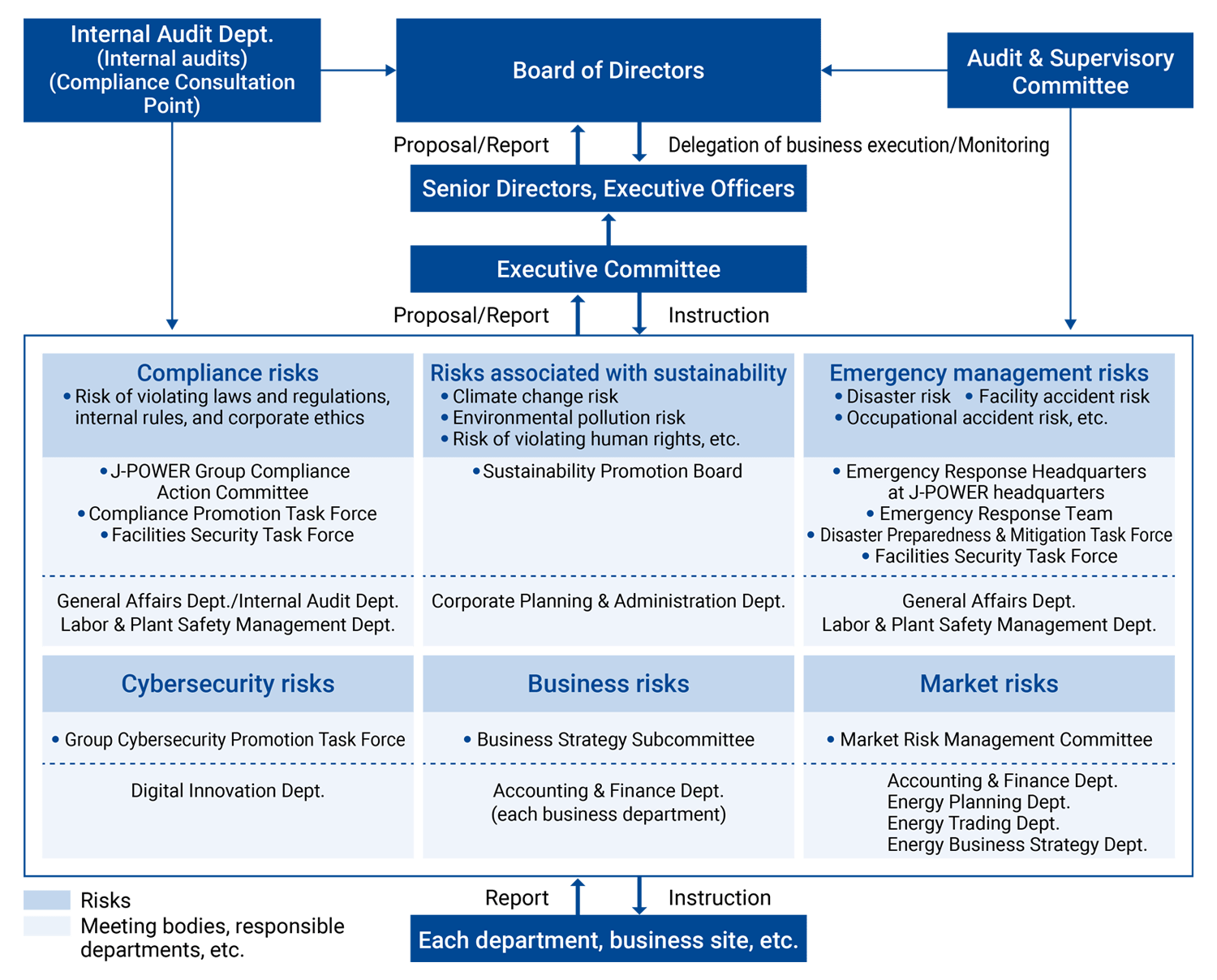
Risk Management Framework Covering ESG Risks
Our risk management framework explicitly covers ESG risks—such as climate change, human rights, and environmental pollution—as “sustainability-related risks.”
- Identification of ESG Risks
As shown in the risk management structure, the Company recognizes “Risks associated with sustainability (including climate change, environmental pollution, and human rights violations)” as material management risks within the scope of risks subject to management. - Assessment by Specialized Committees
These non-financial risks are analyzed and assessed by specialized bodies, including the Sustainability Promotion Board. The outcomes of these assessments are reported through an established process to the Executive Committee and the Board of Directors.