
- Home
- Sustainability
- Society
- Respect for Human Rights
Respect for Human Rights
- Basic Policy on Human Rights
- Promotion Structure
- Human Rights Due Diligence
- Remediation and Grievance Mechanisms
- Training and Education on Human Rights and Compliance Initiatives
- Stakeholder Engagement on Human Rights Issues
Basic Policy on Human Rights
Keenly aware of its responsibility to respect the human rights of those whom its business activities may affect, the J-POWER Group endeavored to clarify its stance on the matter and, in June 2022, fulfilled that responsibility by establishing the J-POWER Group Basic Policy on Human Rights. This policy is based on such international standards as the International Bill of Human Rights, ILO International Labour Standards, OECD Guidelines for Multinational Enterprises, UN Global Compact Principles on Human Rights, and UN Guiding Principles on Business and Human Rights. Based on this policy, we promote efforts to respect human rights for all stakeholders, including those within our supply chain.
The J-POWER Group Basic Policy on Human Rights
Based on the J-POWER Group Corporate Philosophy, we aim to contribute to society through our business activities and to develop in a sustainable way together with society. Guided by our Basic Policy on Sustainability, we are mindful of our responsibility to respect the human rights of people whose lives are impacted by our business activities. We make every effort to meet this responsibility.
We promote initiatives to respect human rights. Therefore, we have established a basic policy on human rights for the J-POWER Group (below, the “Basic Policy”) based on the International Bill of Human Rights (the Universal Declaration of Human Rights and the International Covenants on Human Rights), the ILO Declaration on Fundamental Principles and Rights at Work, the OECD Guidelines for Multinational Enterprises, the Ten Principles of the UN Global Compact, and the UN Guiding Principles on Business and Human Rights.
Scope of the Basic Policy
The Basic Policy applies to all employees and officers of the J-POWER Group. We also encourage our business partners and suppliers to support the Basic Policy and to respect human rights.
Human Rights Initiatives
- At the J-POWER Group, we clarify who is responsible for implementing the Basic Policy and monitor the state of implementation.
- With a mechanism for human rights due diligence in place, we are committed to understanding the risks of having a negative impact on human rights and we work to prevent or reduce such risks.
- If it becomes clear that our business activities have had a negative impact or facilitated a negative impact on human rights, we will take appropriate measures to improve the situation.
- At the J-POWER Group, we have the highest respect for international human rights standards. We respect the following rights and dignities.
- Ban human trafficking, forced labor, and child labor
- Respect for the freedom of association and collective bargaining
- Administer appropriate working hours, eliminate excessive working hours
- Guarantee minimum wage and consider the living wage
- Ensure a healthy and safe working environment
- Protect personal information and privacy
- Prohibit all kinds of discrimination,* harassment, bullying, and unfair treatment
- *By discrimination we mean discrimination based on race, skin color, gender, language, religion, nationality, age, sexual orientation, gender identity, gender expression, disability, political or other opinions, national or social origins, assets, social standing of family, or any other status or similar grounds
- The series of initiatives based on the Basic Policy rely on the expertise of independent outsiders. We also consult in good faith with people who have been impacted by our business.
- We will periodically disclose information on the status of initiatives informed by the Basic Policy.
- We carry out appropriate training and education to ensure that the Basic Policy is integrated with our business activities and implemented effectively across the whole Group.
Signing of the UN Global Compact
In April 2020, J-POWER was registered as one of the corporate signatories of the UN Global Compact (UNGC). At the same time, we joined Global Compact Network Japan, a group composed of Japanese signatories to the compact.
J-POWER has engaged in efforts to improve its corporate value in the fields of environment, society, and governance (ESG). By signing the UNGC and clearly expressing our corporate stance, we will further strengthen our ESG initiatives.
Dissemination and Communication of the Human Rights Policy to Stakeholders
The J-POWER Group promotes the integration of its Human Rights Policy across all stakeholders and embeds respect for human rights throughout every aspect of its business activities. To this end, the Group implements a multi-faceted communication approach as outlined below.
- Raising Awareness and Ensuring Understanding Among All Employees:
The Group conducts regular human rights training for all employees, including both permanent and non‑permanent staff, to ensure thorough understanding and internalization of the Human Rights Policy.
Through these training programs, the Group clearly communicates the standards of conduct expected of employees—such as the prevention of human rights violations and the prohibition of discrimination—and promotes the consistent application of these principles across the organization. - Engagement with Business Partners and Suppliers:
In order to build a sustainable supply chain, the Group directly communicates its human rights expectations to key business partners and suppliers. This includes the distribution of a formal document entitled “Request Regarding Initiatives to Respect Human Rights,” through which the Group explicitly requests compliance with its Human Rights Policy.
By doing so, the Group clearly articulates its expectation that not only its own operations but also its entire supply chain will share common standards for respecting human rights and work collaboratively to mitigate human rights risks. - Public Commitment and Transparent Communication to Society:
The Group publicly discloses its Human Rights Policy on its official website in both Japanese and English.
Through this disclosure, the Group demonstrates its commitment to respecting human rights to a broad range of stakeholders—including local communities, investors, and other domestic and international stakeholders—and strives to ensure transparency and accountability through proactive information dissemination.
Promotion Structure
To effectively promote respect for human rights, the J-POWER Group has established a clear governance framework that combines oversight by senior management with clearly defined day‑to‑day responsibilities and the allocation of appropriate management resources at the operational level.
Board-Level Oversight
Matters related to respect for human rights are subject to oversight by the Board of Directors.
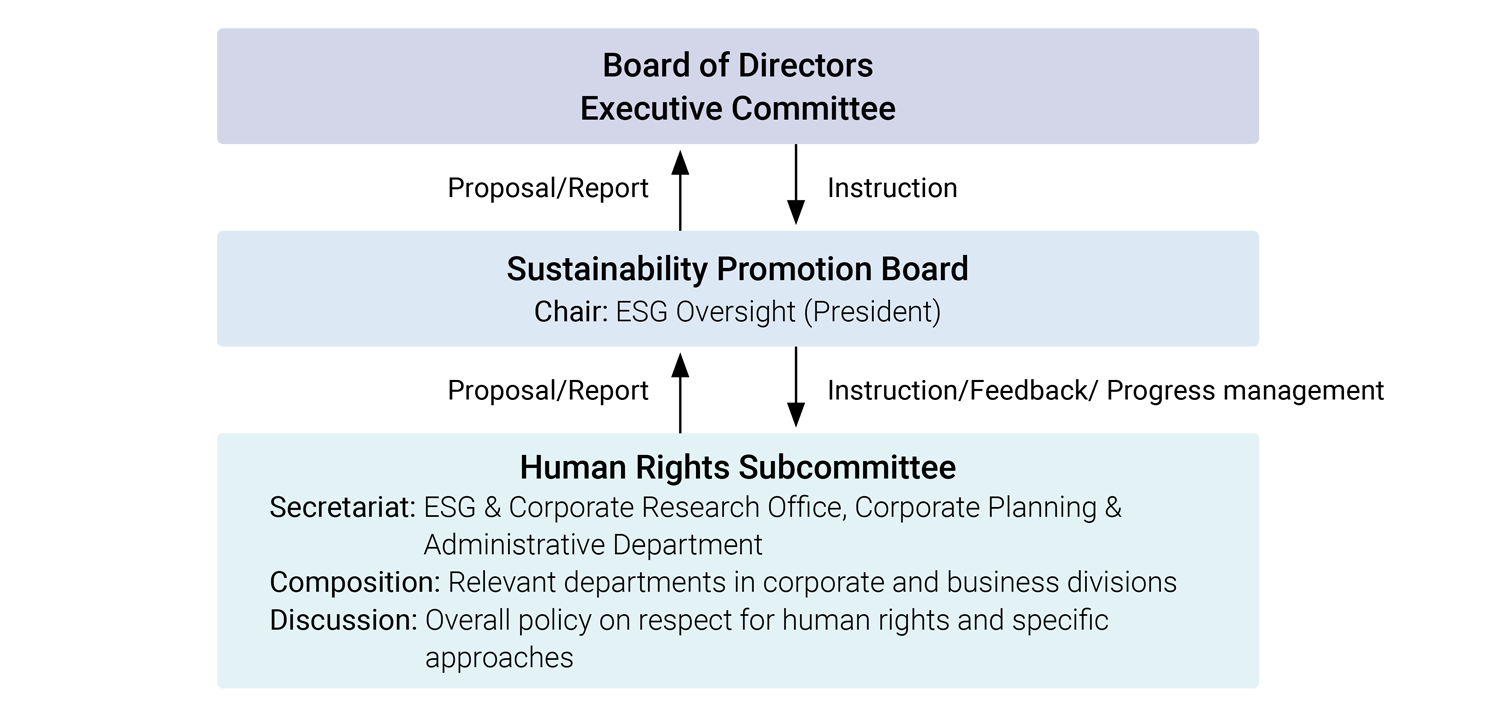
Human rights issues are deliberated by the Sustainability Promotion Council, which is led by the Corporate Planning Department as the responsible division, and the outcomes of these deliberations are regularly reported and proposed to the Board of Directors.
Based on these reports, the Board of Directors provides appropriate direction regarding group‑wide policies and measures related to human rights, thereby ensuring effective governance and oversight.
Structures for Operational Management and Supervision
To ensure the ongoing supervision and promotion of human rights initiatives in daily operations, the Group has established the following framework at the executive and operational levels.
- Executive-Level Oversight Responsibility:
The President, who serves as the executive officer in charge of ESG, is designated as the executive-level supervisor responsible for the implementation and day‑to‑day oversight of human rights initiatives.
This executive directly oversees sustainability promotion activities, including respect for human rights, and holds ultimate executive responsibility for the allocation of resources and the progress of related measures. - Operational Promotion and Management Structure:
A Human Rights Subcommittee has been established under the Sustainability Promotion Board.
Through this subcommittee, members from relevant departments across the organization collaboratively identify human rights issues and examine specific measures on a cross‑functional basis. - Responsible Department and Dedicated Resources:
The Corporate Planning & Administration Department serves as the secretariat for the Human Rights Subcommittee and has been allocated dedicated management resources to conduct human rights due diligence and related information‑gathering activities.
The department manages the operation of the subcommittee and works on a day‑to‑day basis to disseminate policies and develop concrete improvement actions in collaboration with relevant departments and business sites.
Human Rights Due Diligence
The J-POWER Group takes concrete measures to avoid, prevent, and mitigate adverse impacts in relation to high‑priority risk areas identified through its human rights due diligence process.
Identification and assessment of human rights risks
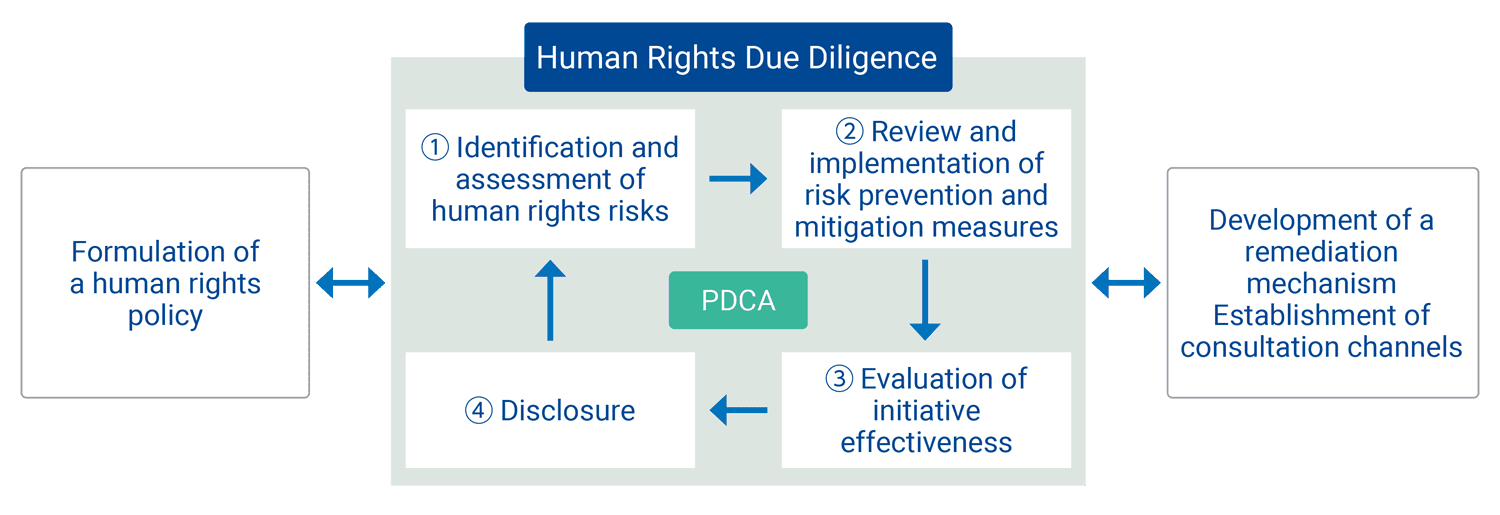
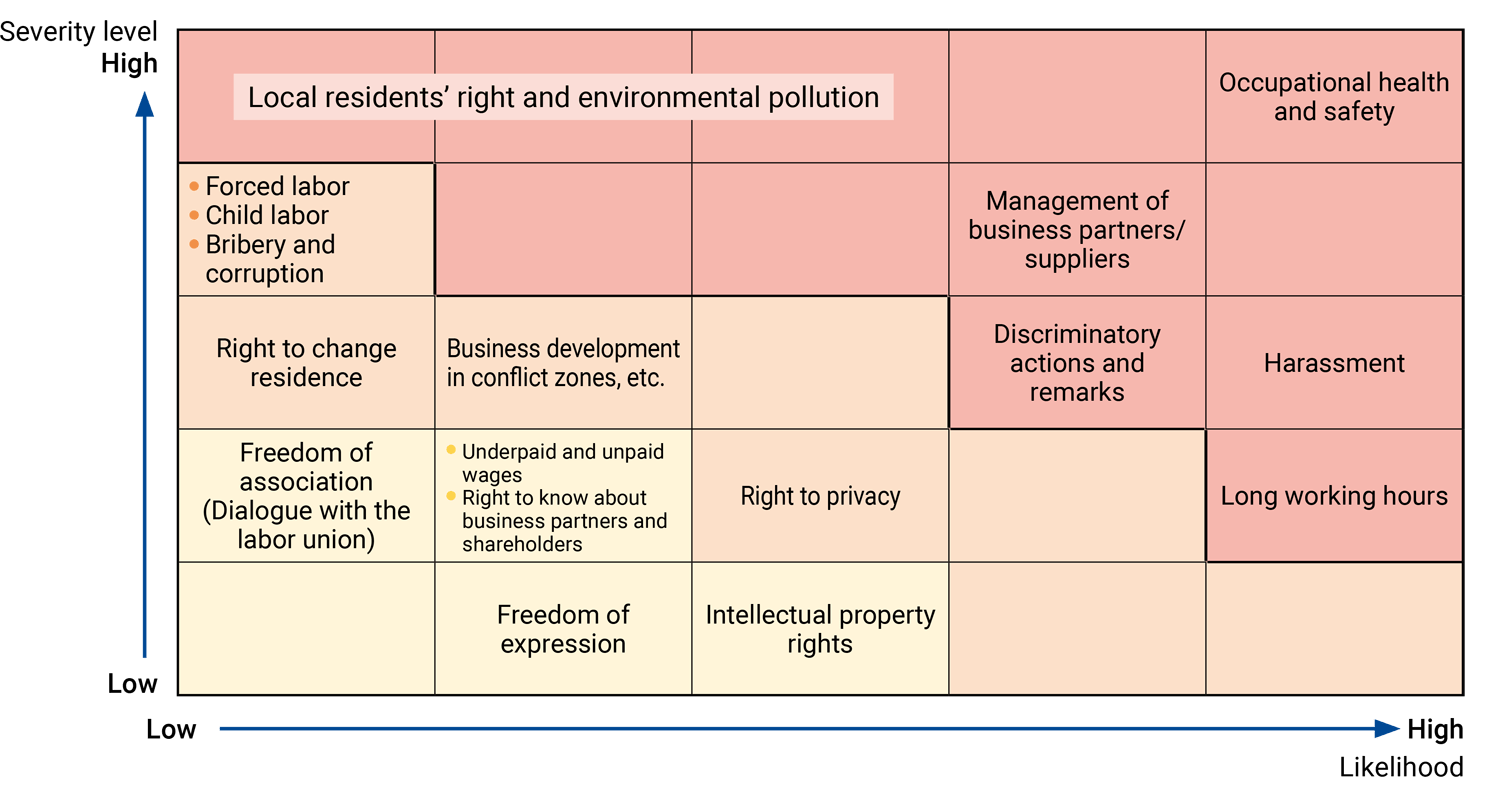
The J-POWER Group implements human rights due diligence through the Human Rights Subcommittee established under the Sustainability Promotion Board. To understand the potential negative impacts and risks to human rights, we organized human rights issues with the assistance of outside experts, in accordance with the UN Guiding Principles on Business and Human Rights and other international guidelines. In FY2023, we administerequestion naires and conducted interviews to identify internal human rights risks. In light of these findings and circumstances unique to J-POWER’s business, the power industry, and J-POWER itself, we performed a human rights risk assessment (risk mapping) to pinpoint high-risk areas. We review and implement prevention and mitigation measures, focusing on these high-risk areas.
In addition, we evaluate the effectiveness of initiatives at the Human Rights Subcommittee at fiscal year-end, report the results of such evaluation to the Board of Directors, to reflect the results in initiatives for the next fiscal year.
Approach to formulating the risk map
- The vertical axis represents the severity level, whereas the horizontal axis indicates the likelihood of occurrence. The prioritization criteria are based on the “Reference Material on Practical Approaches for Business Enterprises to Respect Human Rights in Responsible Supply Chains” issued by the Ministry of Economy, Trade and Industry (METI).
- Severity levels are categorized as high, medium, and low for scale, scope, and irremediability, respectively, based on the above criteria.
- Likelihood is assessed using these criteria, supplemented by quantifying the results from internal questionnaire responses.
Key Human Rights Risks Identified
Taking into account the characteristics of its business activities and the degree of impact on stakeholders, the J-POWER Group has identified the following issues as salient human rights risks for the Group.
- Occupational health and safety
- Local residents’ right and environmental pollution
- Management of business partners/suppliers
- Harassment
- Discriminatory actions and remarks
- Long working hours
Remediation and Grievance Mechanisms
Grievance Mechanisms (Human Rights Inquiry Desks)
The J-POWER Group has established a grievance mechanism specifically addressing human rights issues in order to identify and address adverse human rights impacts arising from its business activities and to provide remedy to affected individuals and local communities.
Through the following contacts, we accept inquiries from employees and officers of our company, group companies, affiliates, and business partners regarding any potential human rights violations or concerns within our company and its group companies' operations or employee behavior. This includes individuals who were employees or officers within one year from the date of the consultation.
The mechanism guarantees confidentiality and anonymity and strictly prohibits retaliation. The privacy and confidential information of complainants are rigorously protected, and anonymous reports are accepted. Throughout the consultation process, complainants are assured that their privacy will be safeguarded and that they will not be subject to any disadvantageous treatment by the Group as a result of raising concerns.
- (Notes on the operation of the grievance mechanism)
For inquiries about our international business, please contact our group companies in each country.
We are unable to respond to inquiries unrelated to our company or cases involving defamations of an individual. We may not be able to respond to your inquiry. Please note that it may take some time to reply.
- Compliance inquiry desk e-mail: compliance_jpower@jpower.co.jp
- Harassment inquiry desk e-mail: harassment@jpower.co.jp
Remediation
Upon receiving a grievance or report, the Group promptly conducts fact‑finding investigations and works to identify issues and implement corrective actions. Where it is identified that the J-POWER Group has caused or contributed to adverse human rights impacts through its business activities, the Group is committed to providing appropriate remedy through proper procedures.
Training and Education on Human Rights and Compliance Initiatives
We conduct various training programs to help directors and employees gain knowledge about compliance, various types of harassment, diversity, and other topics related to respect for human rights. Among these is a program designed to deepen their understanding of the J-POWER Group Basic Policy on Human Rights.
Respect for human rights is also stipulated in the Group’s Compliance Action Guidelines, which are distributed to all employees. In addition, a compliance survey is administered to all Group employees to regularly assess employee awareness, compliance risks, and changes in the environment. The survey is subsequently used to develop measures.
| Level-specific training |
|
|---|---|
| Human rights and compliance training |
|
| e-learning |
|
| Study sessions and lectures |
|
Stakeholder Engagement on Human Rights Issues
The J-POWER Group continuously conducts engagement activities with stakeholders related to its business operations in order to identify human rights risks and promote improvements through ongoing dialogue.
Specific Initiatives
To share priority human rights issues with stakeholders and work collaboratively to reduce related risks, the J-POWER Group undertakes the following initiatives:
- Direct Engagement with Business Partners
Since April 2025, the Group has distributed a letter of request for initiatives reralted to respect for human rights to key business partners and suppliers, formally requesting compliance with its human rights policy. - Participation in External Initiatives
The Group participates in the United Nations Global Compact and enhances its stakeholder engagement activities by incorporating the latest international standards and leading practices from other companies.